The Diary of John Evelyn


Book Description
Dealer Notes
The need for this edition arose from the knowledge that ‘[e]xisting editions [...] were known to be unsatisfactory since they all descended from an unscholarly printed text published in 1818 which was precariously based on inaccessible manuscript originals in the possession of the Evelyn family. By 1920 the combined efforts of A.T. Bartholomew, H. Maynard Smith, and Geoffrey Keynes had spurred the Clarendon Press into contemplating a more adequate edition and in 1921 the Evelyn family were persuaded to deposit the manuscripts in the Bodleian. By 1926 a transcript was available and Francis Meynell was showing an interest in producing a “plain-text” Nonesuch Press edition to be printed at the Press using its Fell types’ (op. cit., p. 418). In 1929, when doubts about the accuracy of the existing transcript arose, de Beer was asked to cast an eye on the same, demonstrating both his competence and ‘the occasional unreliability of the transcriber (who read at one point “vitals and sinews” as “rituals and sermons”)’, and was asked to put together an edition for the Clarendon Press. Of independent means, supported by his mentor Sir Charles Firth, and bringing with him a love for accuracy as well as endurance, de Beer was ideally suited to this task in spite of not being an academic with institutional affiliations. ¶¶
De Beer soon realised that ‘the commentator on a seventeenth-century English diary must enter into the intellectual and cultural milieu of his diarist. The second-hand would not do: knowledge of contemporary culture, politics, literature, language, art, architecture, and travels as evidenced in particular in the publications of the diarist’s day must be at the editor’s finger tips. And with this in mind de Beer began to build up his “Evelyn Collection”, a background library of sources for seventeenth- and eighteenth-century studies’ which informed ‘some 12,000 footnotes’ in the present edition (op. cit., pp. 418-419). The publication of The Diary of John Evelyn was universally applauded on its publication, with one reviewer writing that ‘Mr. de Beer [...] spent some thirty years on this labor amoris, and the result is a definitive edition which reproduces what the diarist actually wrote “as faithfully as type can follow manuscript”. No subsequent scholar need attempt this mountainous task again’ (E.F. Carpenter, review in The Journal of Ecclesiastical History 8.1 (1957), pp. 116-117, at p. 116). Similarly, in his bibliography of Evelyn, Keynes judged that ‘[t]hese six volumes, edited by Dr de Beer with devoted scholarship, are never likely to be superseded. Every available source of information has been used and the Index volume alone occupied the editor for the best part of three years’. ¶¶
This set is from the noted library of the historian of science and bibliophile R.E.W. Maddison, who was educated at King’s College, London where he was awarded a BSc in 1921 and a PhD in 1924. After working as an industrial chemist and a schoolmaster at Wellington College, Maddison devoted his professional energies to the history of science: he held a Leverhulme Research Fellowship in 1962-1964 and was appointed Librarian of the Royal Astronomical Society in 1965, holding the position until his retirement ten years later. As Maddison’s obituarist J.A. Bennett commented, ‘[i]t is remarkable that he achieved so much in a field which he came to, at least professionally, late in life. […] His major work as a historian was The Life of the Honourable Robert Boyle, published by Taylor & Francis in 1969’ (‘Obituary R. E. W. Maddison (1901-93)’, Annals of Science, vol. 52 (1995), p. 306), and Maddison was also an editor of Annals of Science from 1966 to 1974. The son of a bookseller, Maddison was ‘an ardent and perceptive book collector’ and ‘[f]or many years he acted as a consultant on scientific books to the old-established antiquarian bookseller, Edward G. Allen’ (R.E. Maddison, ‘Robert Edwin Witton Maddison (1901-1993)’, Quarterly Journal of the Royal Astronomical Society, vol. 36 (1995), p. 457-458 at p. 457); unsurprisingly, he amassed a large and wide-ranging library, which reflected the breadth of his interests not only in the history of science, but also literature, history, music, languages, and other fields. Maddison has annotated the text of volumes I to V of this set with cross-references to volume VI (Additions & Corrections). ¶¶
G.L. Keynes, John Evelyn, 147a. ¶¶
This set is available directly from our website (www.TypeAndForme.com). Alternatively, please contact us for any enquiries.
Other books
If you liked the book you've just seen, you might be interested in other books from the same dealer below.
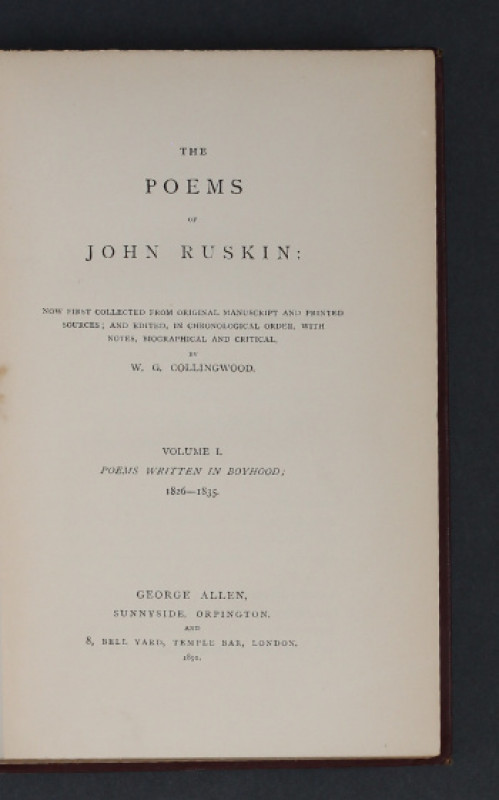
The Poems ... Now First Collected from Original Ma...
RUSKIN, John
Orpington and London: Ballantyne Press for George Allen
£69.50
Offered by Type & Forme
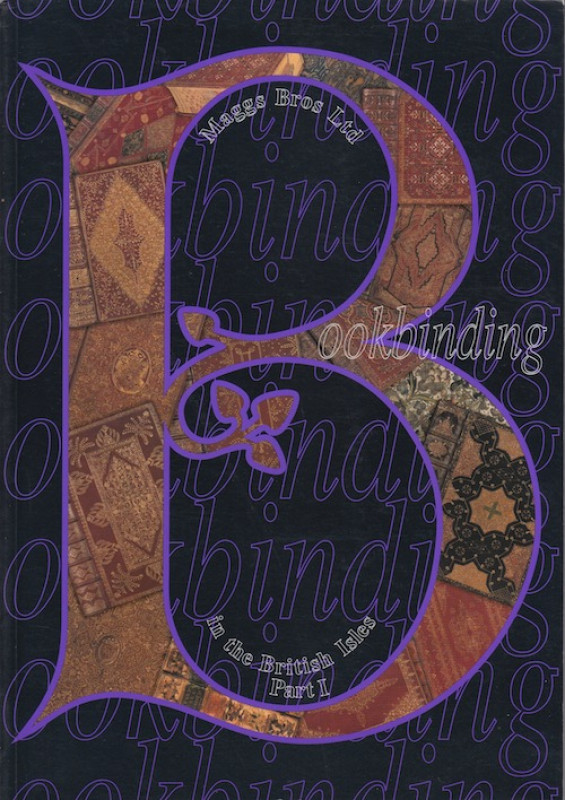
Bookbinding in the British Isles Sixteenth to Twen...
MAGGS BROTHERS LTD
London: B.A.S. Printers Limited for Maggs Bros Ltd
£79.50
Offered by Type & Forme
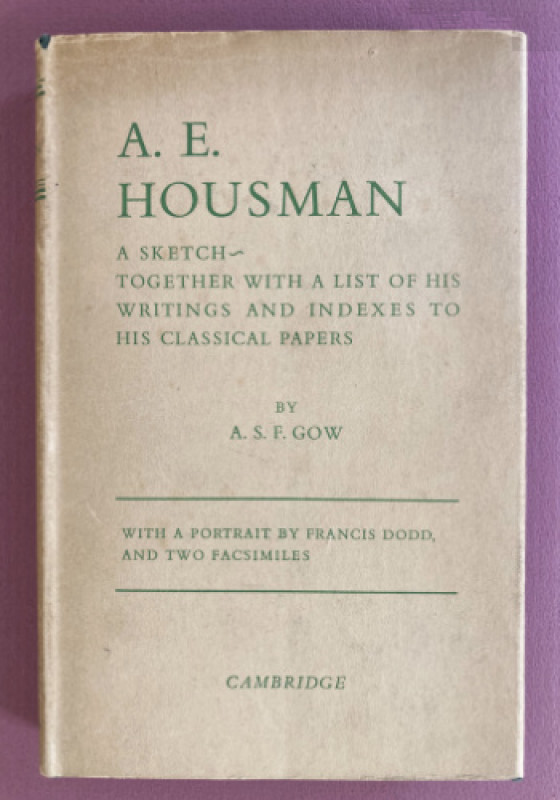
A.E. Housman, A Sketch. Together with a List of hi...
HOUSMAN, Alfred Edward – Andrew Sydenham Farrar GOW
Cambridge: The University Press
£37.50
Offered by Type & Forme

Desert Marsh and Mountain. The World of a Nomad.
THESIGER, Sir Wilfred Patrick.
London: W. & J. Mackay Limited for William Collins Sons and Co Ltd.
£75.00
Offered by Type & Forme
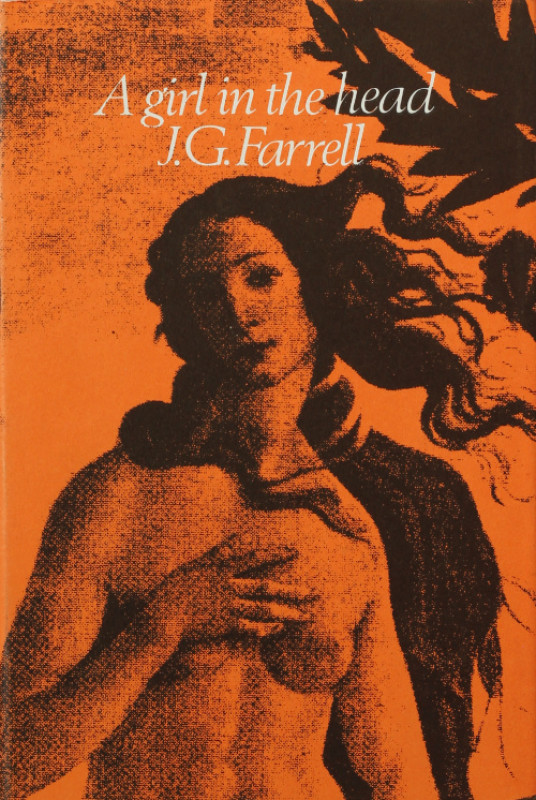
A Girl in the Head
FARRELL, James Gordon
London: Ebenezer Baylis and Son, Ltd, The Trinity Press for Jonathan Cape
£275.00
Offered by Type & Forme
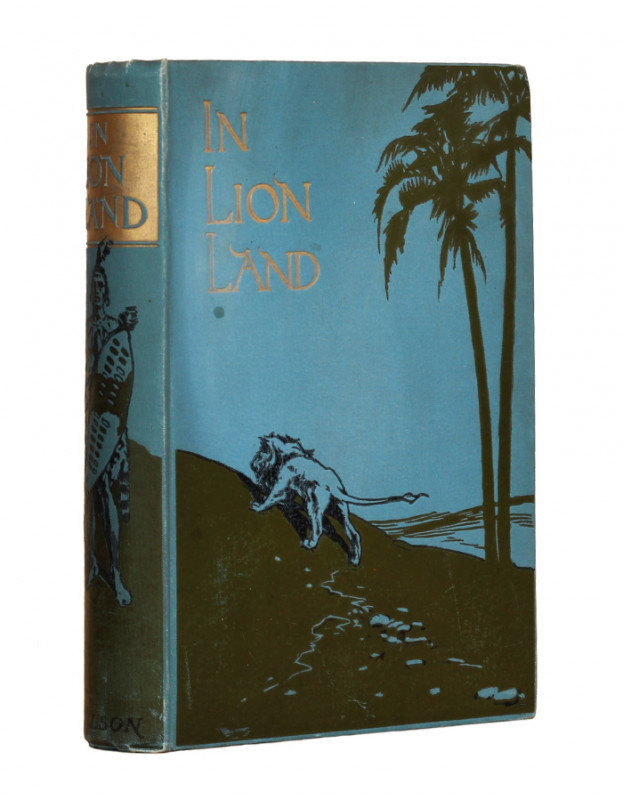
In Lionland: The Story of Livingstone and Stanley...
DOUGLAS, Mary
London, Edinburgh and New York: Thomas Nelson and Sons
£69.50
Offered by Type & Forme

The Labouring Life (signed limited ed.)
WILLIAMSON, Henry William
London and Toronto: The Alden Press for Jonathan Cape
£250.00
Offered by Type & Forme

History of the Expedition to Russia, Undertaken by...
SÉGUR, Philippe-Paul, comte de
London: W. Clowes for H.L. Hunt and C.C. Clarke
£495.00
Offered by Type & Forme
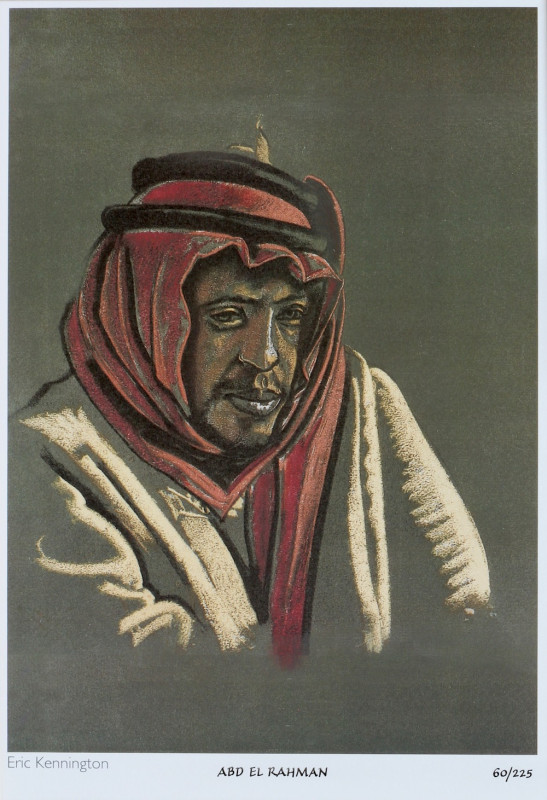
‘Abd el Rahman’ [portrait for Seven Pillars of Wis...
[T.E. Lawrence] -- KENNINGTON, Eric Henri
Fordingbridge: Castle Hill Press
£95.00
Offered by Type & Forme

‘Experimental Researches in Electricity – Thirtiet...
FARADAY, Michael.
London: Richard Taylor and William Francis [for the Royal Society],
£149.50
Offered by Type & Forme
Friends of the PBFA
Please email info@pbfa.org for more information